CUDA
Fundamentals
CPU vs GPU
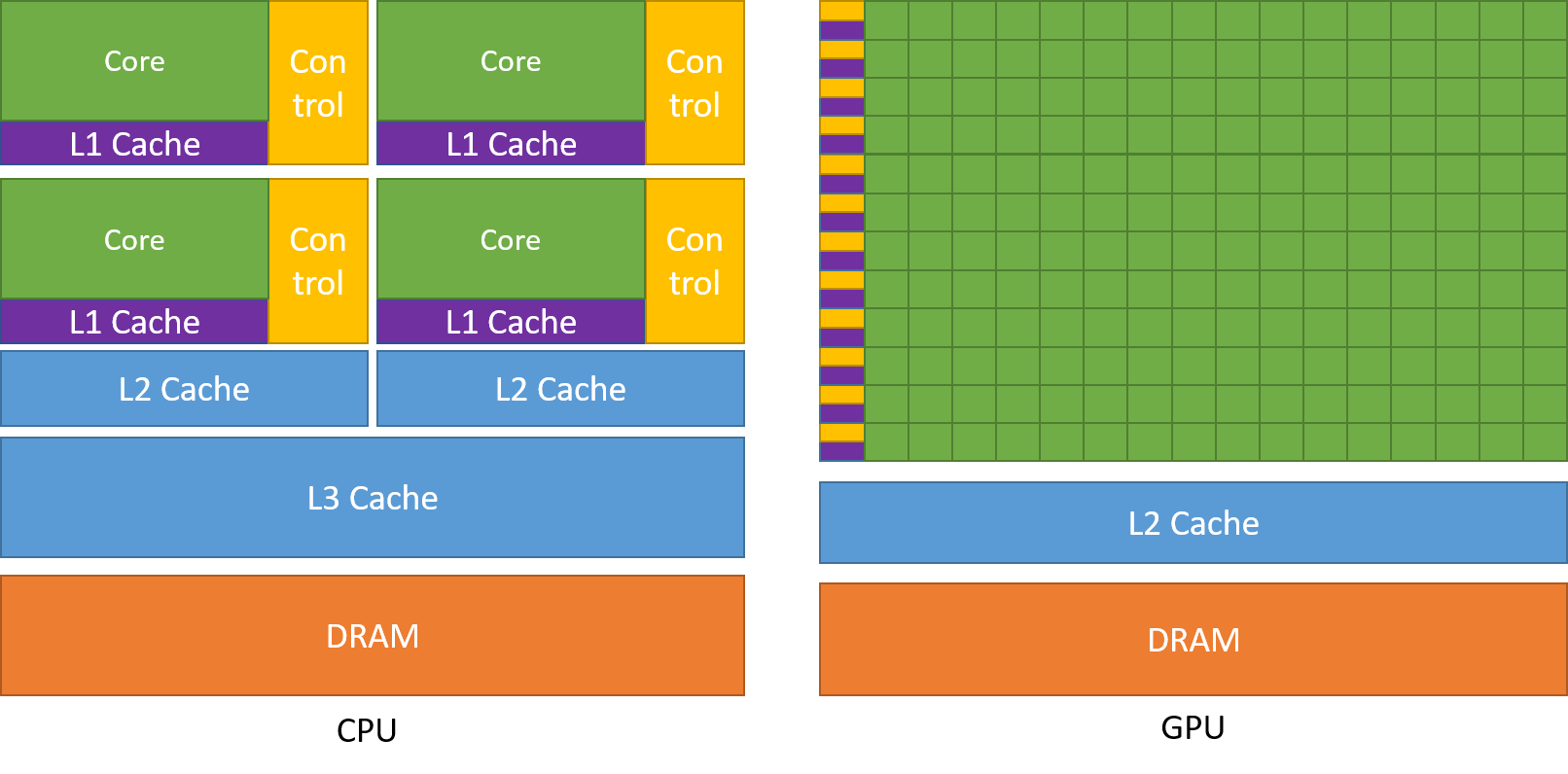
CPU 关注延迟,而 GPU 关注吞吐
| Aspect | CPU | GPU |
|---|---|---|
| Clock frequency | High | Moderate |
| Caches | Large - convert long-latency memory accesses into short-latency cache accesses | Small - primarily to boost memory throughput |
| Control complexity | Sophisticated control; Branch prediction to reduce branch latency; Data forwarding to reduce data latency | Simple control; No branch prediction or data forwarding |
| ALU design | Powerful ALU — reduced operation latency | Energy-efficient ALUs — many units; long latency but heavily pipelined for high throughput |
| Latency tolerance strategy | Rely on caches + speculation + out-of-order/control logic to reduce exposed latency | Require a massive number of threads to tolerate (hide) latencies |
| Winning | For sequential parts where latency hurts | For parallel parts where throughput wins |
Process vs Thread
Process 是操作系统分配资源和调度执行的基本单位,
- 拥有独立的虚拟地址空间、页表与内存映射、打开的文件描述符表、信号处理配置、环境变量、进程控制块信息
Thread 是计算的基本单元,Process内可被操作系统独立调度的最小执行单位
- 共享进程资源(地址空间、代码段、堆、全局变量、打开的文件、socket)
- 独立的程序计数器、寄存器上下文、栈、调度状态以及线程局部存储
CUDA Kernel - Grid, Block, Thread (Single Program Multiple Data)
A CUDA kernel is executed as a grid (array) of threads
- All threads in a grid run the same kernel code
- Single Program Multiple Data (SPMD model)
- Each thread -> Unique index -> compute memory addresses and make control decisions
Threads within a block cooperate via shared memory, atomic operations and barrier synchronization
Threads in different blocks cooperate less
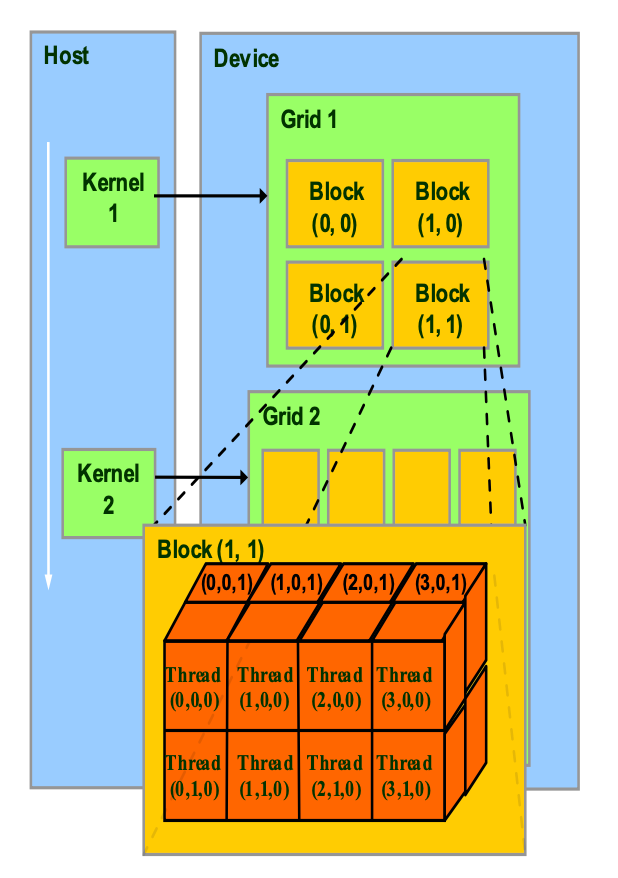
Thread block and thread organization simplifies memory addressing when processing multidimensional data
Memory API
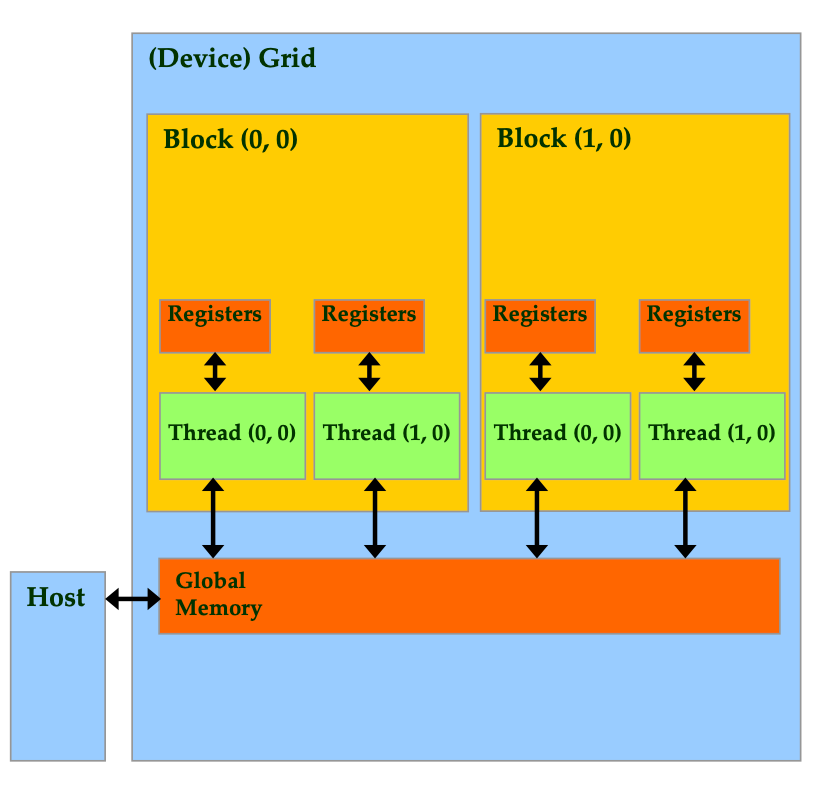
cudaMalloc()
- Allocates object in the device global memory
- Two parameters
- Address of a pointer to the allocated object
- Size of the allocated object in terms of bytes
cudaFree()
- Frees object from device global memory
- Pointer to freed object
cudaMemcpy()
- memory data transfer
- Requires four parameters
- Pointer to destination
- Pointer to source
- Number of bytes copied
- Type/Direction of transfer (
cudaMemcpyHostToDevice,cudaMemcpyDeviceToHost)
CUDA Function Declarations 函数声明
| Excuted | Callable | |
|---|---|---|
__device__ float DeviceFunc() | device | device |
__global__ void KernelFunc() | device | host |
__host__ float HostFunc() | host | host |
Compiling A CUDA Program
flowchart TD
%% ======================
%% CUDA 编译链
%% ======================

CuFile[".cu (CUDA C++)"] --> NVCC["NVCC"]
NVCC -- ".c (Host C/C++ code)" --> HostCompiler["Host C/C++ Compiler"]
NVCC -- ".ptx (PTX(Virtual) ISA code)" --> JIT["Device Just-in-Time Compiler"]

HostCompiler -- "Host Assembly (e.g. x86, Power, ARM)" --> CPU
JIT -- "Device Assembly (e.g. SASS)" --> GPU
CUDA 编程注意事项
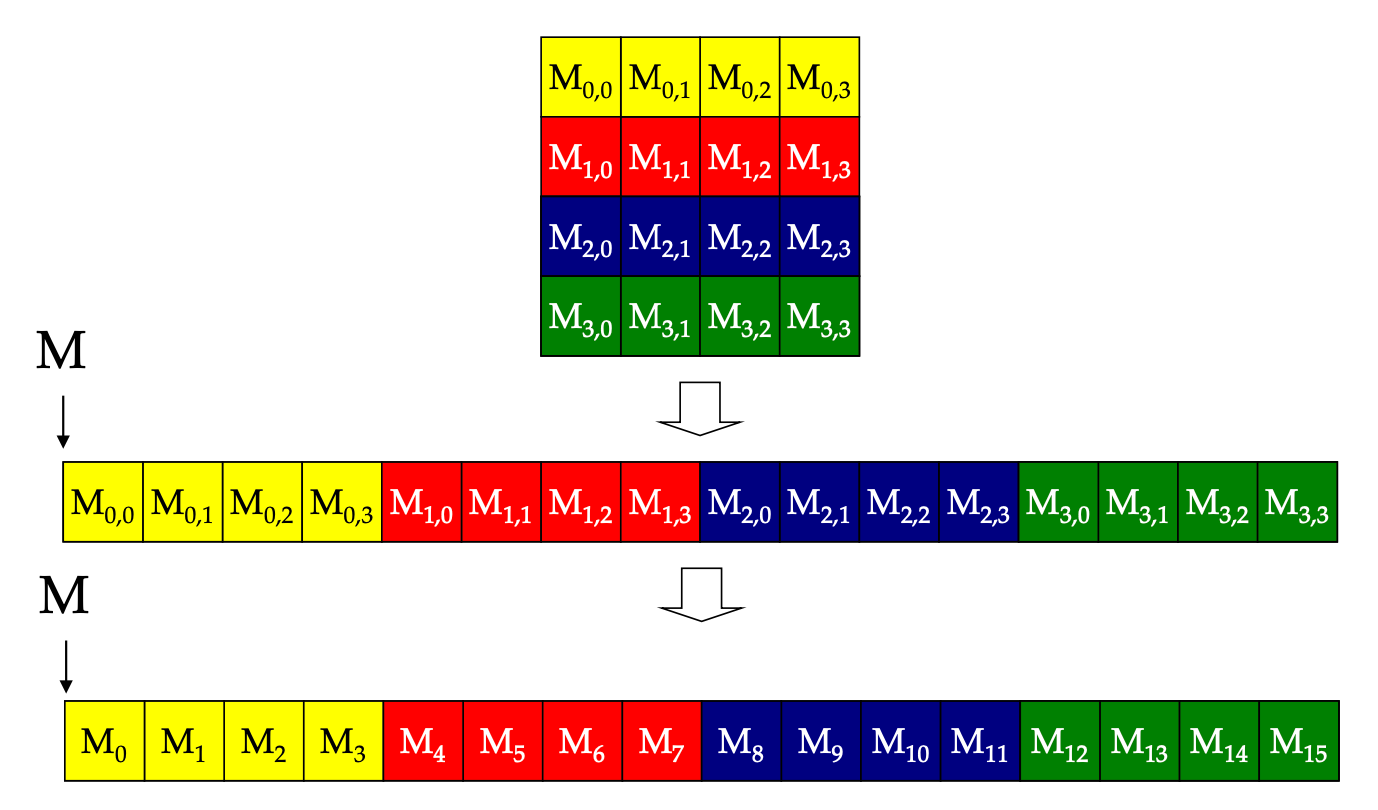
- Row-Major Layout of 2D Arrays in C/C++
- 边界条件:Handling boundary conditions for pixels near the edges of the image (如卷积核)
Grid, Block, Thread 续
- Threads in the same block share data and synchronize while doing their share of the work
- Threads in different blocks cannot cooperate
- Blocks execute in arbitrary order
Block/Threads 与 SM/Warp 关系
Block 分配给 SM (Streaming Multiprocessors,包括shared memory,SP - Streaming Processor) SM 同时有 block limit 和 thread limit Threads 同时运行,由 SM 维护 thread/block id,manages/schedules thread execution
e.g. Each block is executed as 32-thread warps
- An implementation decision, not part of the CUDA programming model
- Warps are divided based on their linearized thread index
- Threads 0-31: warp 0
- Threads 32-63: warp 1, etc.
- Warps are scheduling units in SM
写代码时看到的是 thread,但硬件调度时看的往往是 warp
flowchart TD

subgraph r1[Code]
direction LR
Grid
Block
Thread
end

subgraph r2[Hardware]
direction LR
SM
Warp
end

Block --> SM
Thread --> Warp
SM implements zero-overhead warp scheduling
- 如果某 warp 的下一条指令所需操作数已经 ready,它就 eligible
- scheduler 从 eligible warps 中选一个执行
- 当某个 warp stall 时,SM 可以切换到其他 ready warps。
GPU latency tolerance 的本质,通过足够多的 ready warps 来覆盖延迟 —> occupancy 的意义
Pitfall: Control/Branch Divergence
Branch divergence:threads in a warp take different paths in the program (发生条件:must depend on something unique to the thread)
GPUs use predicated execution -> 每条path都计算 -> Multiple paths taken by threads in a warp are executed serially! 分支变串行!
if (threadIdx.x > n) {
    // THEN
} else {
    // ELSE
}
ALL THREADS EXECUTE BOTH PATHS
SOLUTION: 让分支粒度按 warp 大小对齐
if (threadIdx.x / WARP_SIZE > 2) {
    // THEN
} else {
    // ELSE
}
Still has two control paths, but all threads in any warp follow only one path. 避免 warp 内 divergence.
Block Granularity Considerations For colorToGreyscaleConversion, should one use 8×8, 16×16 or 32×32 blocks? Assume that in the GPU used, each SM can take up to 1,536 threads and up to 8 blocks.
- For 8×8, we have 64 threads per block. Each SM can take up to 1,536 threads, which is 1,536/64=24 blocks. But each SM can only take up to 8 Blocks, so only 512 threads (16 warps) go into each SM!
- For 16×16, we have 256 threads per block. Each SM can take up to 1,536 threads (48 warps), which is 6 blocks (within the 8 block limit). Thus, we use the full thread capacity of an SM.
- For 32×32, we have 1,024 threads per Block. Only one block can fit into an SM, using only 2/3 of the thread capacity of an SM.
结合 SM 的 threads/block 数上限
Memory
The Von-Neumann Model
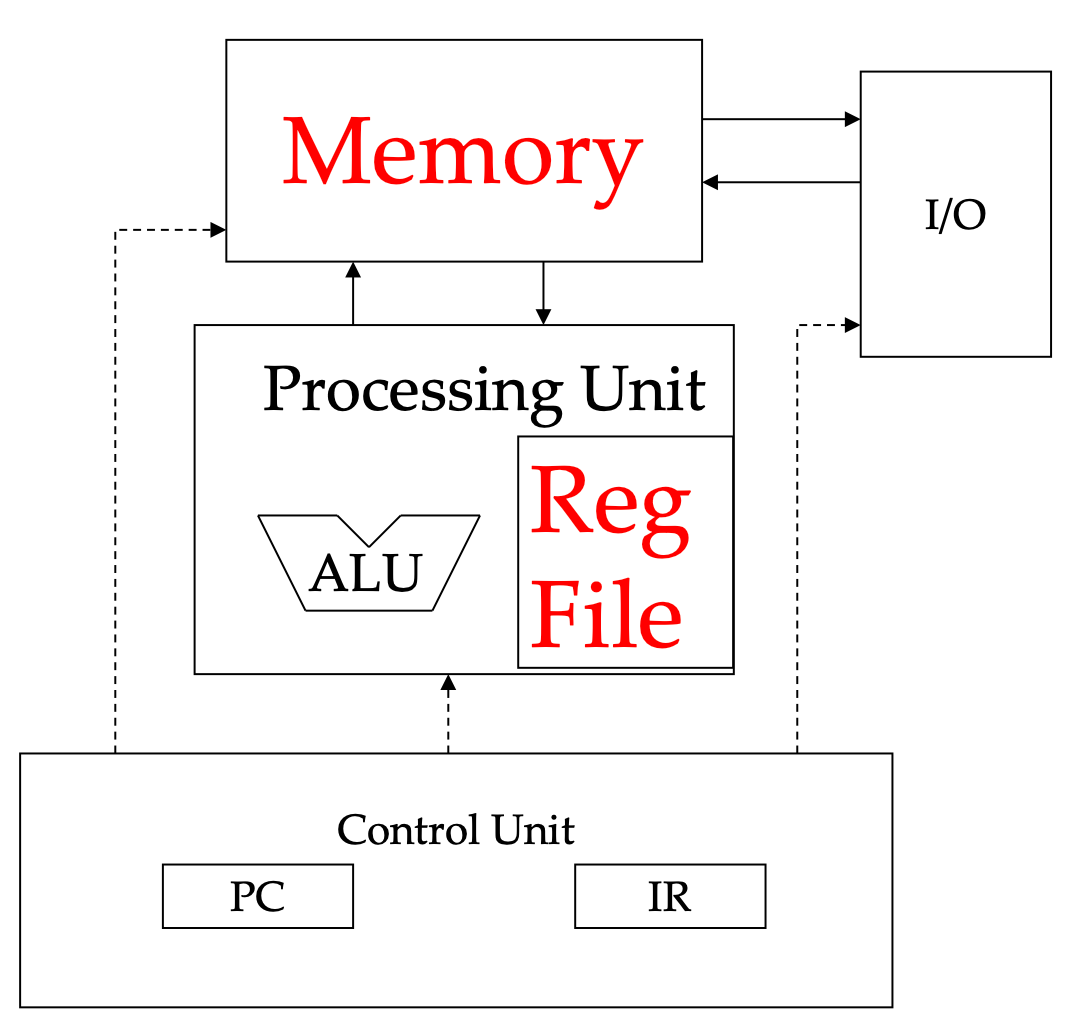
Instruction processing: Fetch | Decode | Execute | Memory
Each thread can: – read/write per-thread registers (~1 cycle) – read/write per-block shared memory (~5 cycles) – read/write per-grid global memory (~500 cycles) – read/only per-grid constant memory (~5 cycles with caching)
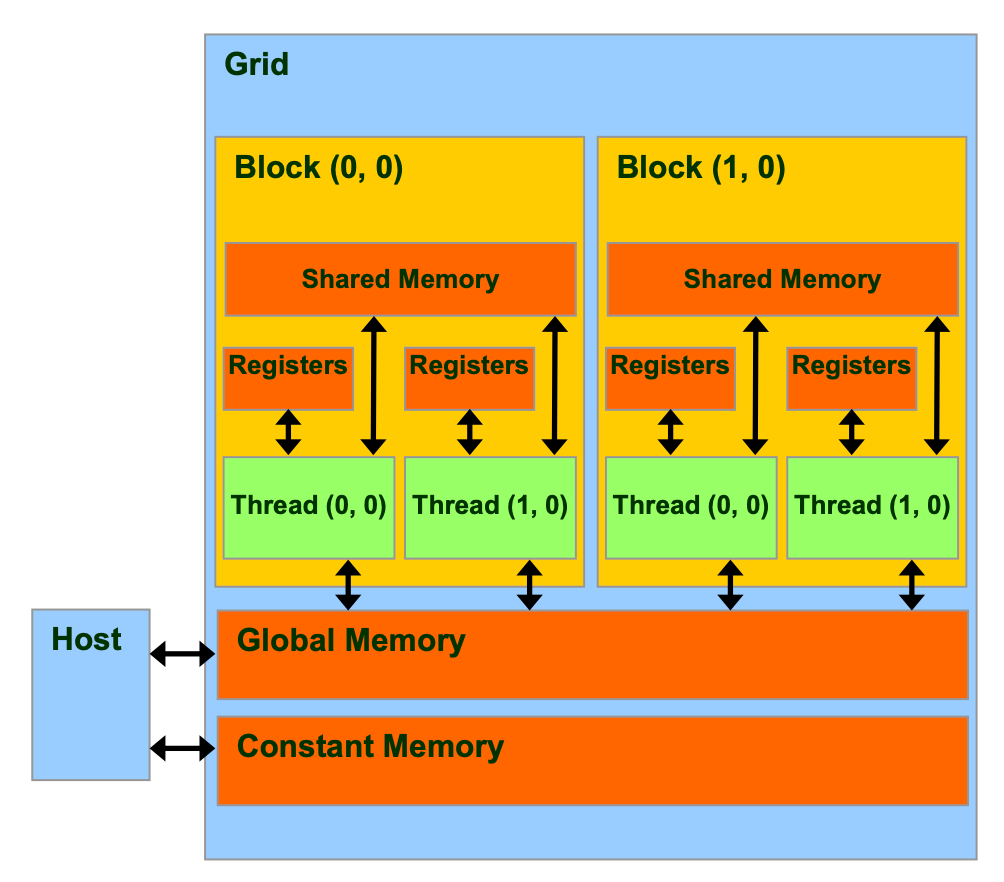
| Variable declaration | Memory | Scope | Lifetime |
|---|---|---|---|
int LocalVar; | register | thread | thread |
__device__ __shared__ int SharedVar; | shared | block | block |
__device__ int GlobalVar; | global | app. | application |
__device__ __constant__ int ConstantVar; | constant | app. | application |
__device__ |
- optional with
__shared__or__constant__ - not allowed by itself within functions Automatic variables with no qualifiers
- in registers for primitive types and structures
- in global memory for per-thread arrays
MM - Matrix Multiplication
二维 grid/block tile baseline
dim3 dimGrid(ceil((1.0*Width)/TILE_WIDTH),
             ceil((1.0*Width)/TILE_WIDTH), 1);
dim3 dimBlock(TILE_WIDTH, TILE_WIDTH, 1);
MatrixMulKernel<<<dimGrid, dimBlock>>>(Md, Nd, Pd, Width);
__global__
void MatrixMulKernel(float* d_M, float* d_N, float* d_P, int Width)
{
    int Row = blockIdx.y * blockDim.y + threadIdx.y;
    int Col = blockIdx.x * blockDim.x + threadIdx.x;

    if ((Row < Width) && (Col < Width)) {
        float Pvalue = 0;
        for (int k = 0; k < Width; ++k)
            Pvalue += d_M[Row * Width + k] * d_N[k * Width + Col];
        d_P[Row * Width + Col] = Pvalue;
    }
}
A simple implementation -> GPU kernel is the CPU code with the outer loops replaced with per-thread index calculations -> bad performance
Why?
Global memory bandwidth can’t supply enough data to keep the SMs busy.
Accesses to global memory: d_M[Row * Width + k], d_N[k * Width + Col], d_P[Row * Width + Col]
Each Thread Requires 4B of Data per FLOP. How to Compute?
- Every threads access global memory -> for elements of M and N, 4B each, or 8B per pair. (And once TOTAL to P per thread—ignore it.)
- With each pair of elements, a thread does a single multiply-add -> 2 FLOP (floating-point operations)
- So for every FLOP, a thread needs 4B from memory -> 4B / FLOP.
For N GB/s of memory bandwidth, 这正是 roofline thinking 的雏形:上限不是只看峰值 FLOPS,还要看带宽和计算强度。 只是理想带宽上限,实际运行更少,memory is not busy all the time, 以及访存调度不完美、pipeline stall ...
What to Do? Reuse Memory Accesses! -> drastically cut down accesses to Global Memory
Global Memory -> Shared Memory
Global memory is implemented with DRAM -> slow -> tile the input data to take advantage of Shared Memory
- Read tile(s) into shared memory using multiple threads to exploit memory-level parallelism.
- Compute based on shared memory tiles.
- Repeat.
- Write results back to global memory.
__shared__ float subTileM[TILE_WIDTH][TILE_WIDTH];
__shared__ float subTileN[TILE_WIDTH][TILE_WIDTH];
Tiled Multiply
tiling 为什么会大幅提高理论性能上限?
Observe that each input element of M and N is used WIDTH times. 如果 tile 是 W×W,那么每个加载进来的 operand 会被用于 W 次运算,于是 global memory accesses 减少 W 倍 -> bandwidth limit 提高 W 倍。
tiling 提高的是 arithmetic intensity
For each tile,
- Phase 1: Load tiles of M & N into share memory
- 每个线程加载一个 M 元素和一个 N 元素 -> 加载工作被线程并行分担
- 并且要让一个 warp 内的访问尽量 coalesced
- Phase 2: Calculate partial dot product for tile of P
// Step1 (2D indexing) -> (But 1D indexing only)
M[Row][q*TILE_WIDTH+tx]
-> M[Row*Width + q*TILE_WIDTH + tx]
N[q*TILE_WIDTH+ty][Col]
-> N[(q*TILE_WIDTH+ty) * Width + Col]

// Step2
subTileM[ty][k] * subTileN[k][tx]
tile 大小不只看 reuse,也要看 block 线程数、shared memory 占用、active blocks/threads per SM 等资源约束
Barrier Synchronization __syncthreads()
线程怎么知道别的线程已经把 tile 加载完 -> Synchronize!
How does Bulk Synchronous work? Use a barrier
__syncthreads()
All threads in the same block must reach the __syncthreads()
before any can move on
Device Query
Number of devices in the system
int dev_count;
cudaGetDeviceCount(&dev_count);
Capability of devices
cudaDeviceProp dev_prop;
for (i = 0; i < dev_count; i++) {
	cudaGetDeviceProperties(&dev_prop, i);
// decide if device has sufficient resources and capabilities
}
cudaDeviceProp is a built-in C structure type
- dev_prop.maxThreadsPerBlock
- dev_prop.sharedMemoryPerBlock
- …
tile 边界处理
边界非整数倍 Width
- Threads that calculate valid P elements but can step outside valid input
- Threads that do not calculate valid P elements
Write 0 for Missing Elements (If yes, proceed to load; Otherwise, just write 0 to shared memory) -> Benefit: No specialization during tile use
For Threads outside of P calculate 0, but store nothing. 防止 out of index
for (int m = 0; m < (Width - 1)/TILE_WIDTH + 1; ++m)
// Tile loading
if (Row < Width && m*TILE_WIDTH+tx < Width) {
	// as before
	subTileM[ty][tx] = M[Row*Width + m*TILE_WIDTH+tx];
} else {
	subTileM[ty][tx] = 0;
}

if (m*TILE_WIDTH+ty < Width && Col < Width ) {
	// as before
	subTileN[ty][tx] = N[(m*TILE_WIDTH+ty)*Width+Col];
} else {
	subTileN[ty][tx] = 0;
}

// save a little energy (fewer floating-point ops)
if (Row < Width && Col < Width) {
	// as before
	for (int k = 0; k < TILE_WIDTH; ++k)
		Pvalue += subTileM[ty][k] * subTileN[k][tx];
}

// write back
if (Row < Width && Col < Width) {
	// as before
	P[Row*Width+Col] = Pvalue;
}
Note
- Conditions are different for M and N elements
- Branch divergence affects only blocks on boundaries, and should be small for large matrices.
- What about rectangular matrices?
DRAM (multi banks, Burst & Coalesce)
Random Access Memory (RAM): same time needed to read/write any address
Dynamic RAM (DRAM):
- bit stored on a capacitor
- connected via transistor to bit line for read/write
- bits disappear after a while (around 50 msec, due to tiny leakage currents through transistor), and must be rewritten (hence dynamic)
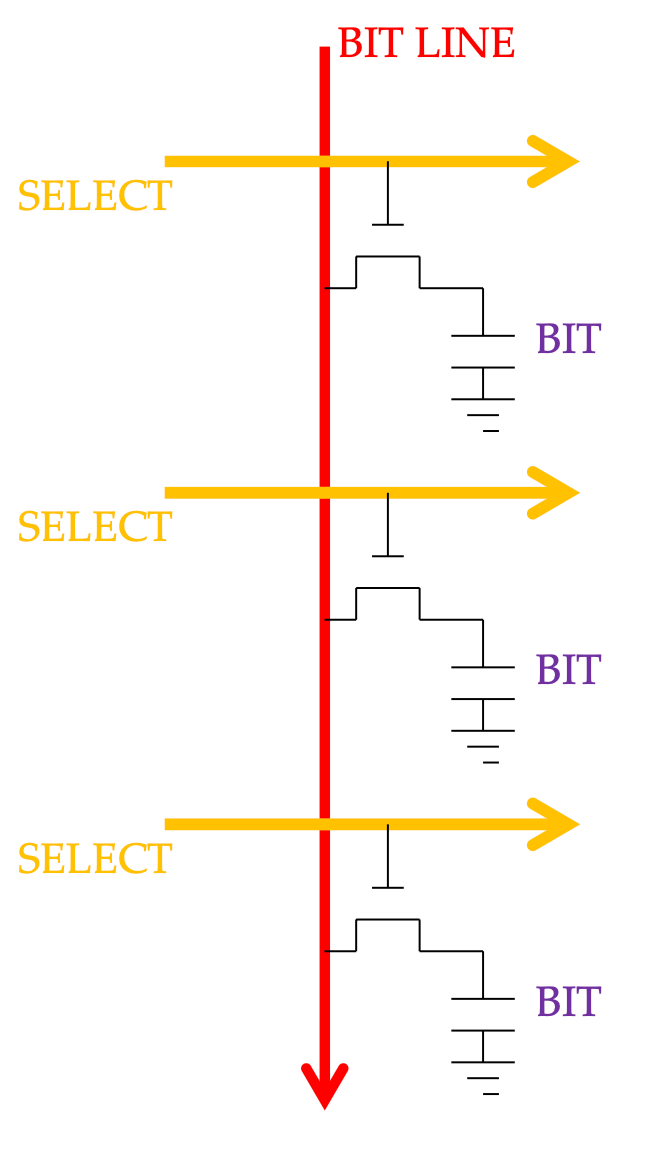
- About 1,000 cells connect to each BIT LINE.
- Connection/disconnection depends on SELECT line.
- Some address bits decoded to connect exactly one cell to the BIT LINE.
Capacitance is tiny for the BIT, but huge for the BIT LINE -> Use an amplifier for higher speed! -> still slow, but only need only need 1 transistor per bit -> DRAM is Slow, Dense & Cheap
SELECT lines connect to about 1,000 bit lines. Core array has about O(1M) bits Use more address bits to choose bit line(s).
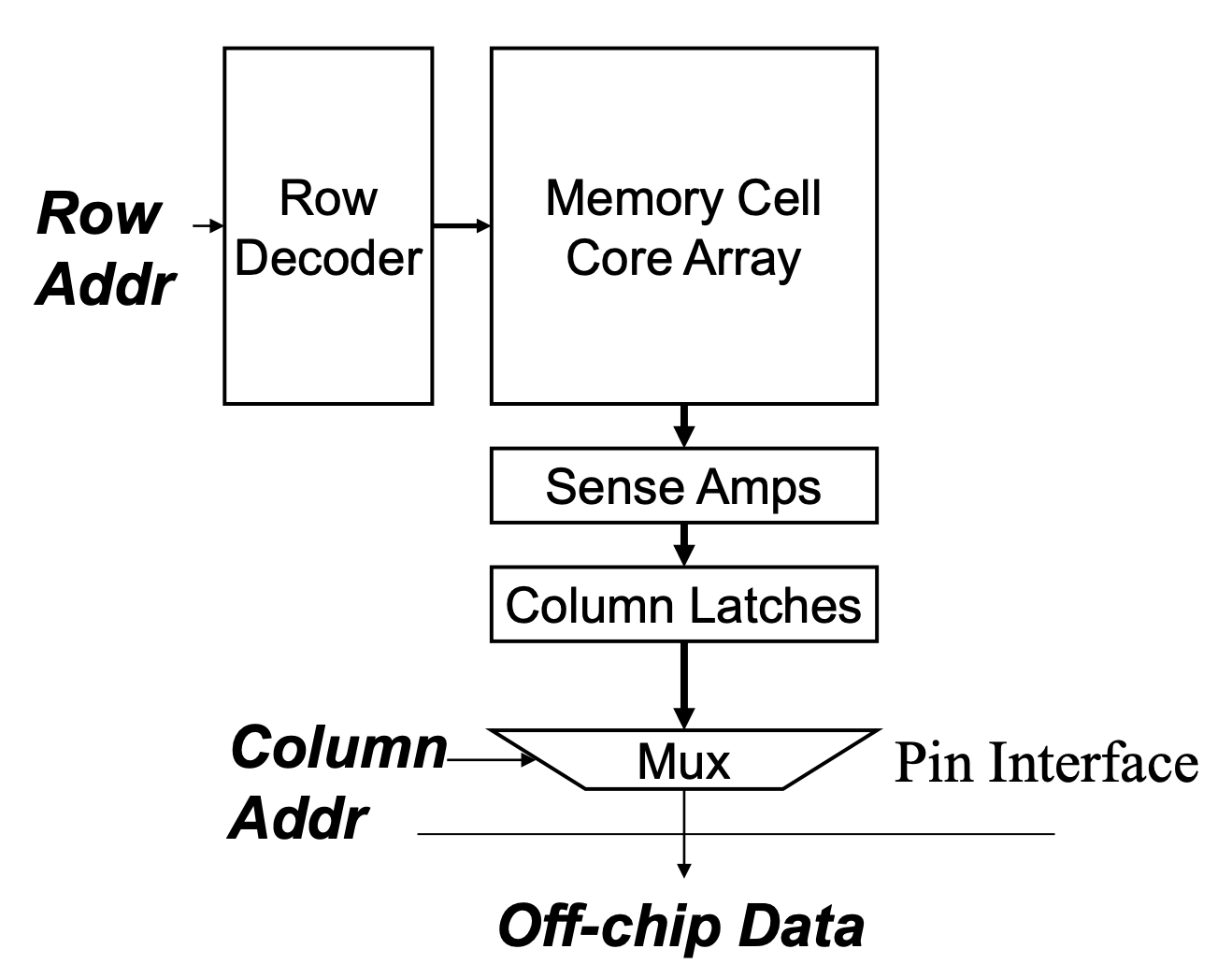
DRAM cells are not clocked (clocking requires transistors). DRAM interfaces are clocked.
- DDR: Core speed = ½ interface speed
- DDR2/GDDR3: Core speed = ¼ interface speed
- DDR3/GDDR4: Core speed = ⅛ interface speed
- … likely to be worse in the future
现代 DRAM 几乎总是按 burst mode 工作 core array access delay 很大, 连续送多个相邻数据更划算
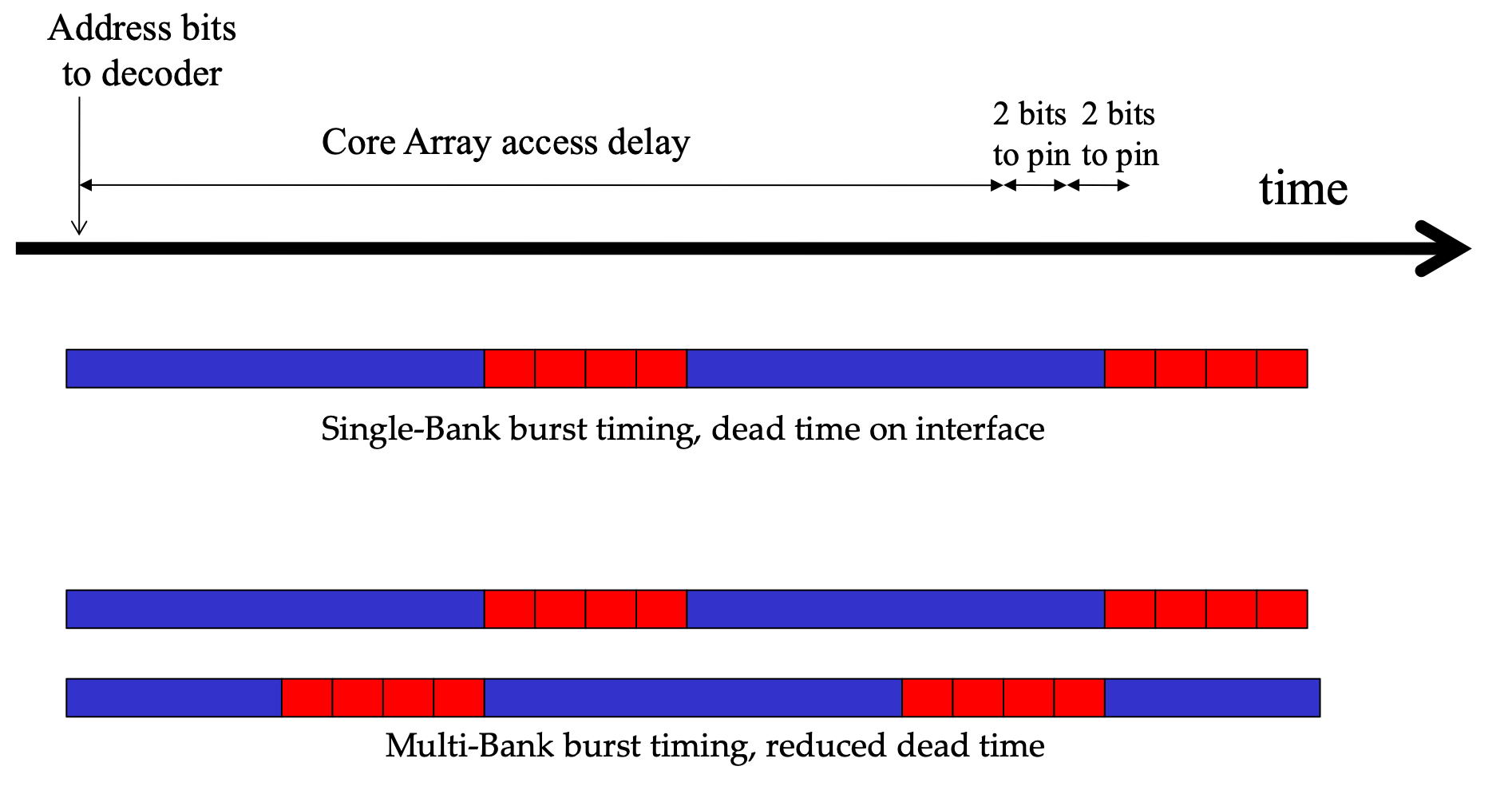 multiple banks 把不同 bank 的访问交错起来 -> 提升吞吐
For naive matmul, N accesses are coalesced, M accesses are not coalesced.
Tiled matmul use shared memory to enable coalescing.
Convolution
ghost cells (apron cells, halo cells)- 支持边界附近的局部邻域计算而引入的外围数据区,常设为0
mask (convolution kernel / filter) - a good candidate for Constant Memory
Cache & Locality
A cache is an “array” of cache lines cache line: data from several consecutive memory addresses Additional hardware is used to remember the addresses of the data in the cache line
memory bursts contain around 1024 bits (128B) from consecutive addresses
Memory Accesses Show Locality
- Spatial locality: when the data elements stored in consecutive memory locations are accessed consecutively
- Temporal locality: when the same data element is accessed multiple times in short period of time
Caches are smaller than memory When cache is full, must make room for new line, usually by discarding least recently used line.
Shared Memory vs. Cache
同
- In terms of distance from the SMs, shared memory is similar to L1 cache
- Both on chip (SRAM), with similar performance 异
- Programmer controls shared memory contents (scratchpad). 程序员显式管理
- Microarchitecture automatically determines contents of cache. 硬件自动管理
Constant Cache vs. L1 Cache
普通 L1 cache 要支持写回,因为 global memory 里的数据可能被修改,所以需要额外逻辑追踪 dirty status
constant cache 面向的是 kernel 执行期间不会被修改的只读数据,因此硬件可以做更激进、更轻量的优化,使得吞吐比一般 L1 更高
Constant Memory
Allocate device memory for M (the mask)
- outside of all functions
__constant__- For copying to device memory, use
cudaMemcpyToSymbol(dest, src, size, offset = 0, kind =cudaMemcpyHostToDevice)
GPU L2/L1 Caches
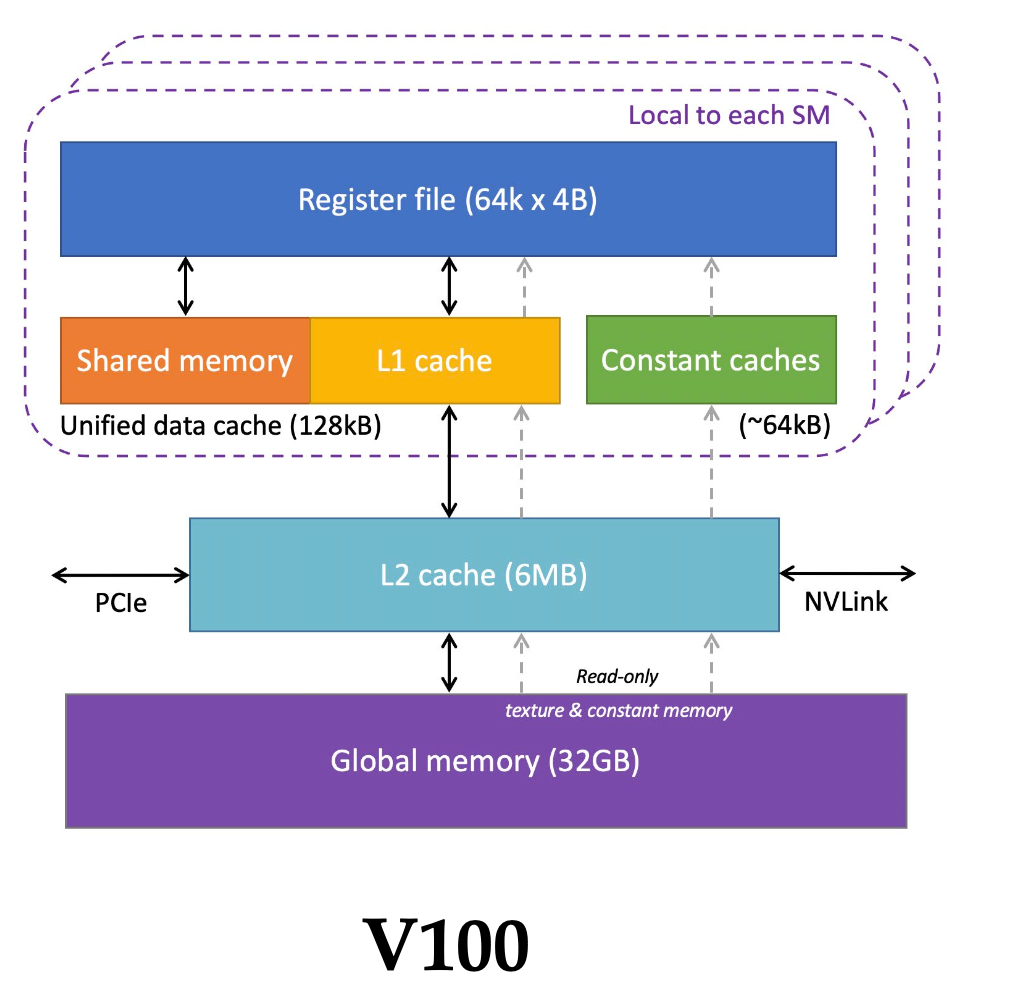
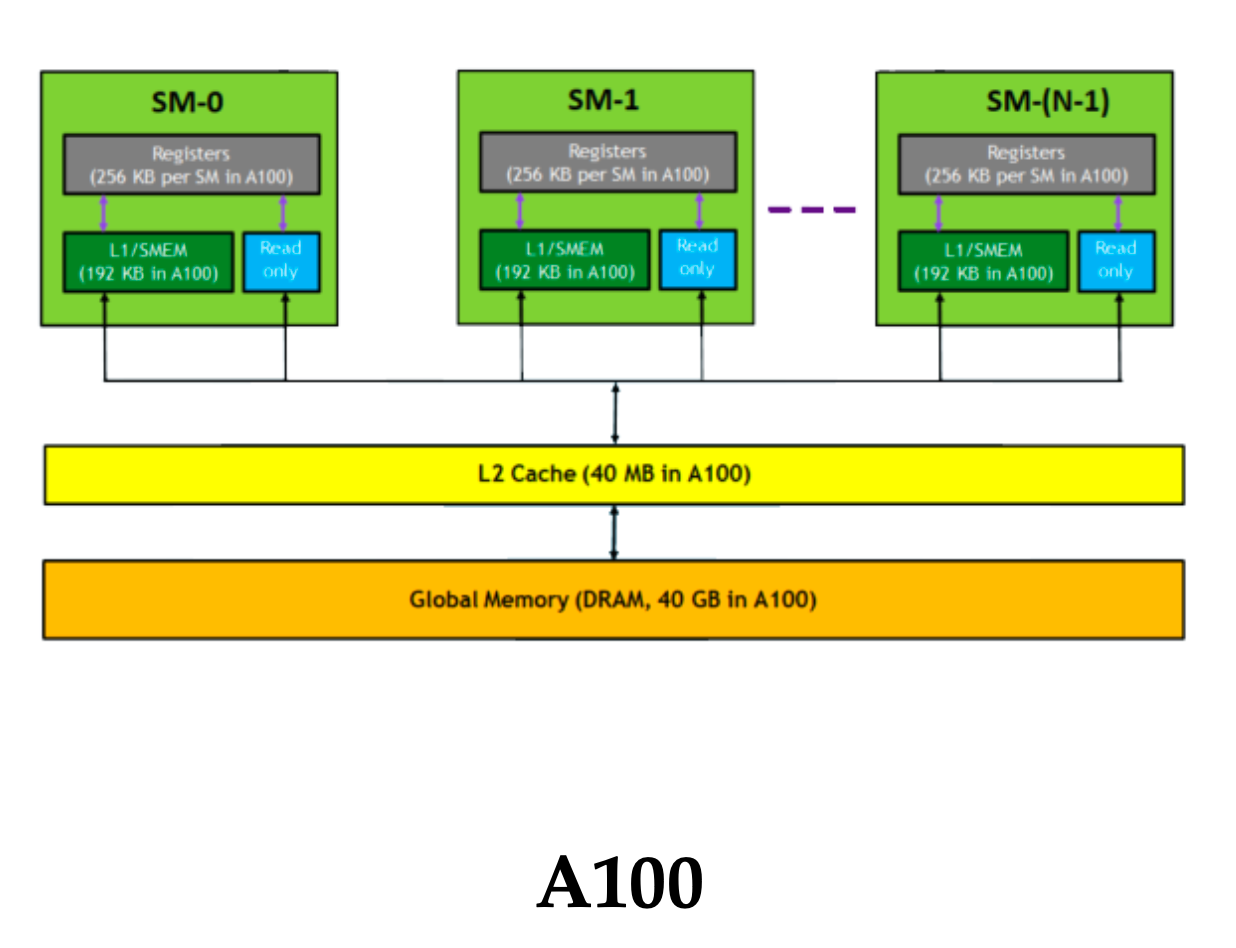
Tiled Convolution
reuse data read from global memory -> shared memory
Halo Access from Global Memory?
- Optimize reuse of shared memory (halo reuse is smaller)
- Branch divergence; Halo too narrow to fill a memory burst to Shared Memory?
- Coalesce global memory accesses; No branch divergence during computation
- Some threads must do >1 load, so some branch divergence in reading; Slightly more shared memory needed
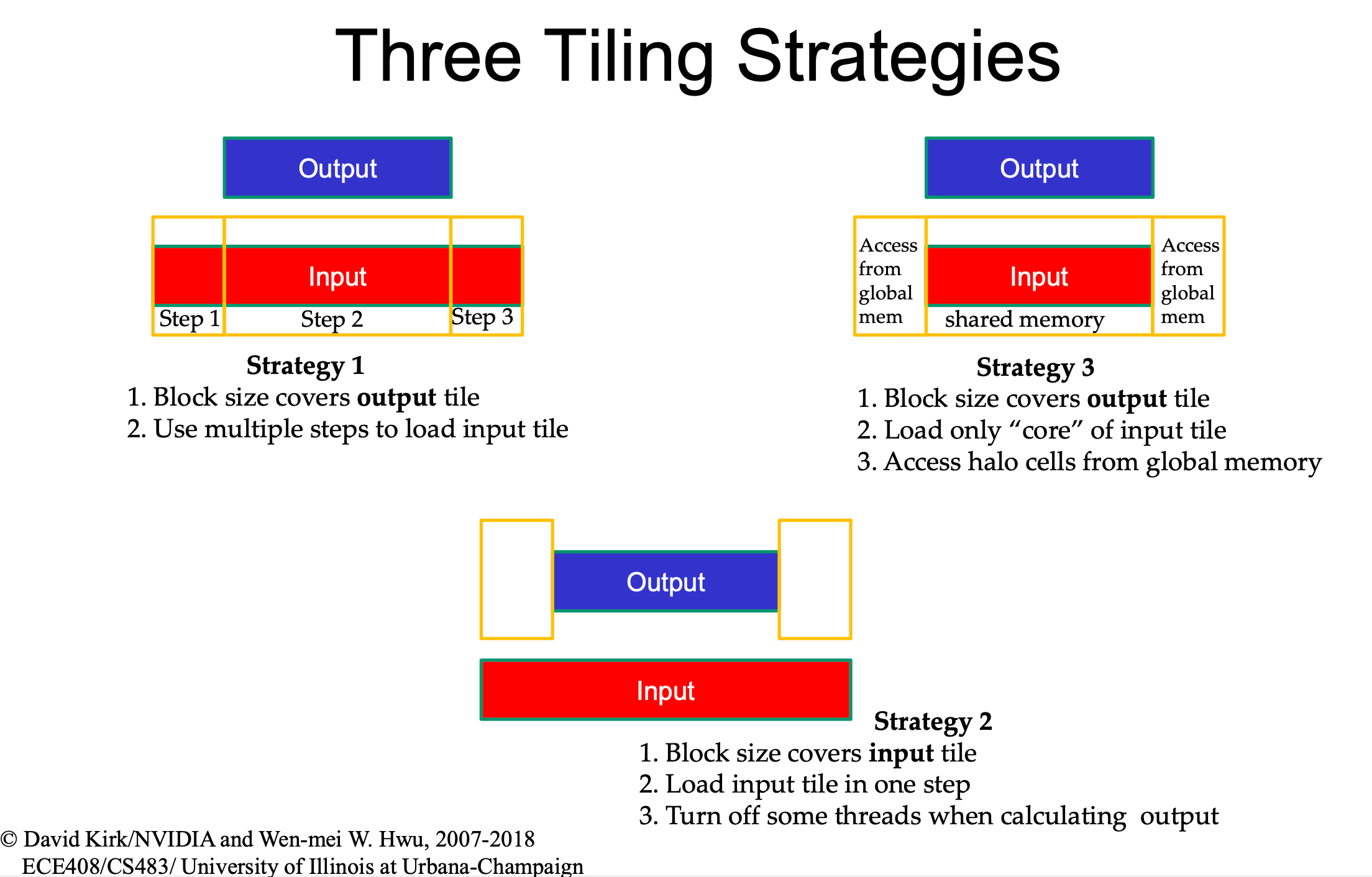
CUDA Programming
- Reduce, softmax, rms_norm, layer_norm, Transpose
- bank conflict, roofline 分析, fusion, tiling 策略
- Flash attention v1 v2 v3
- naive softmax -> safe softmax -> online softmax -> FA1 FA2 FA3
- CUDA -> PTX -> SASS
Cutlass Programming
- tensorcore, cute, ldswizzle, ldmatrix 等等
- sgemm, scemv, hgemm, hgemv
- hopper: TMA, WGMMA, fp8
- mma, wmma, wgmma
Cute
Triton
内存层级
Host mem -> HBM -> reg, L1 -> HBM -> Host mem
Reference
本章内容整理自 UIUC ECE408/CS483/CSE408 Applied Parallel Programming 课后作业:https://github.com/JerryLinyx/LeNet-CUDA-ECE408 类似课程:CMU 15-418, Stanford CS149
Textbook
Wen-mei Hwu, David Kirk and Izzat El Hajj, “Programming Massively Parallel Processors: A Hands-on Approach,” Morgan Kaufman Publisher, 4th edition, 2022, ISBN 978-0-323-91231-0. The book can be downloaded from ScienceDirect.
NVIDIA documentation
- NVIDIA Developer Blog (NVIDIA DB)
- NVIDIA, CUDA Programming Guide (CUDA PG)
- NVIDIA, CUDA C++ Best Practices Guide (CUDA BPG)
- NVIDIA Toolkit CUDA Archived Documentation
Other resources
- https://github.com/gpu-mode/lectures
- https://github.com/xlite-dev/LeetCUDA
- https://github.com/karpathy/llm.c
- 有没有一本讲解gpu和CUDA编程的经典入门书籍? - JerryYin777的回答 - 知乎
- reed - 知乎